

60 Days And Counting: The Kids Reckon the Social Media Ban Isn’t Working
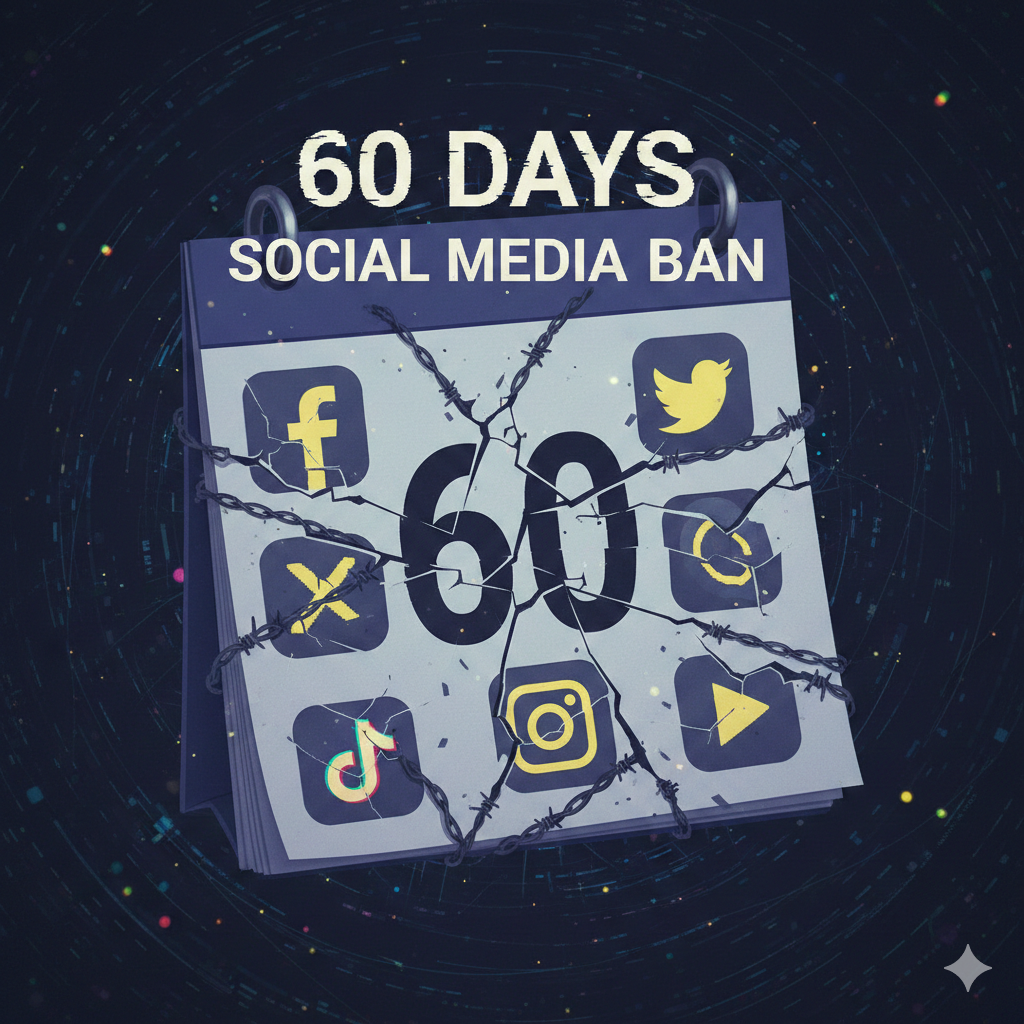
Sweeping countless personal products aside, many things that take 60 days to show any useful sign of change.
Physical transformation with a new exercise regimen. Changes to eating habits that don’t feel like they’re changes. Moving from unconscious incompetence to conscious incompetence. (Which sounds kind of bad, but it’s actually really good.) Settling into a new role. Learning a new system. All sorts of new situations and alterations take around 21 days to not feel so new; and about 60 days for any type of cumulative result on the way to becoming as embedded as whatever it replaced.
At least that’s the theory.
Australia’s Under-16 Social Media Ban
Australia’s social media ban for anyone under the age of 16 is a world first, and implemented two weeks before Christmas 2025. Who knows what some households had to grapple with: the start of six weeks school holidays, the arrival (or not) of Santa; and kids going through ‘the change’ that had nothing to do with menopause but may have produced rather similar symptoms. Like moodiness, sleeplessness, anxiety, feelings of loss of self and brain fog.
Increased facial hair is a bad result of menopause and a very good result for pubescent boys – so there’s a plus.
Other countries have tried as well
Prior to this ban, in similar response to reducing screen time and protecting minors from cyberbullying and crime, other countries have also limited the access of minors to social media platforms.
Italy legislated in 2018 that under-14s needed parental consent for an account. French law has required the verification of user age, along with parental consent for under 15s since mid 2023.
In 2024, the Spanish government approved the draft law that the age of data protection consent be raised from 14 years of age to 16, in terms of the ownership of a social media account. It decided to go further by banning access to games with ‘loot boxes’ for under-18s, where purchases open an often disappointing surprise that leads to more purchases, more disappointment, and on it goes. For those engaging in the generation of deepfakes, there are prison sentences.
You can’t AI yourself out of that.
Denmark has proposed an under-15 ban because of the negative impacts of social media on childhood in general, with its affects on concentration, personal skills and mental health. Its new legislation however, will allow parents to grant 13-and-14-year-olds access, following a specific assessment.
Clearly, it’s seen to be a worldwide problem, although the answer to it is far from simple, and more than difficult to enforce.
Enforcement Challenges
Australia is not the only country to have social media companies face massive fines ($AU49.5 million) for failing to take “reasonable steps” to prevent systemic failure in under-16s holding accounts. Exactly how that would be successfully monitored is anyone’s guess, since consecutive federal governments have failed getting these megacorps to even pay tax.
Only 29-35% of parents view it as part of their duty to ensure their children comply; and this could be an overestimation depending on how the survey was conducted. The remainder have admitted to leaving it to their kids to self-manage.
Locked out for some, business as usual for others
Maybe they’ll let them teach themselves to drive as well. It’s hard to say.
There are plenty of arguments for every aspect of this poorly constructed ban. One of which that doesn’t seem to come up, is the example set by adults in the first place. In the monkey-see-monkey-do world of children and young teens, do-as-I-say-not-as-I-do doesn’t work well. There’s a possibility that the parents unwilling to monitor the internet usage of their kids are largely unable to restrict their own. Parents have also cited examples of being able to manage their child’s own account through the likes of Google Family and setting additional controls. Now they’re just a guest receiving inappropriate and unrelated content.
Meanwhile, all the platforms continuing to make billions upon billions out of the business that is known to cause widespread damage to children and adults alike remain completely unaccountable, for reasons they don’t even have to justify.
Early Impact and Loopholes
It’s quite sobering that 8-year-olds use social media. At least they did before 10 December 2025; they’re not using it now.
Allegedly.
The federal government said that more than 4.7 million under-16 social media accounts had been either removed or deactivated since the ban came into effect, citing that the ban was “working”.
Amid technical limitations that age estimation is accurate only within 2-3 years, (which could be an exaggeration in itself) only a minority were actually booted off; probably around 10%.
A snapshot being a 15-year-old who was locked out of her accounts while it was business as usual for her 13-year-old sister. Many had backdated their birth year when they originally set up the account, so they’re well under the radar.
It seems the ban has also produced a spate of money-making opportunities. Under-16s simply pay older friends or people they know to do ID scans for them. So even accounts that were initially banned prove a minor hurdle for a minor. Prompted face scans more often than not will allow access to the account holder because it doesn’t have the capacity for precise age identification.
IT restrictions on anything are usually considered great solutions by those who know little about technology, and pretty terrible by anyone who does. In this instance, accounts have been either reactivated, or new ones set up.
Political Points vs. Practical Reality
If the whole thing has been for political point scoring, then it can only tally highly under its own system that is already declaring the ban a success.
For everyone else, it’s much more like trying to get the toothpaste back in the YouTube. There’ll be TikToks about that. Ask a 14-year-old. They’ll find them for you.