
Trump, Iran and the Digital Shift: How It Is Influencing Global Power Dynamics
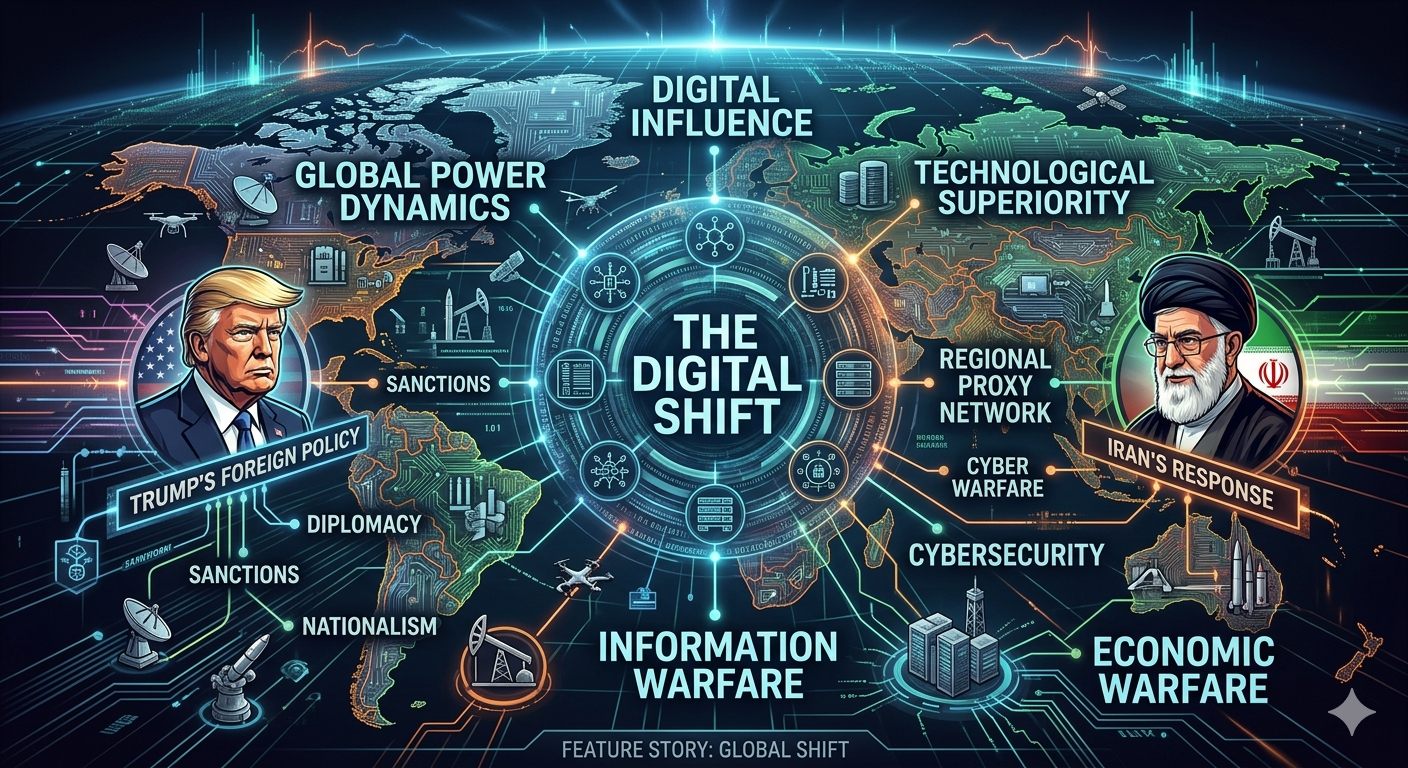
The relationship between Donald Trump and Iran has become a defining case study in how global power is evolving in the digital age. What once relied primarily on military force and diplomatic negotiation now unfolds across economic systems, cyber domains, and information networks. This transformation is not merely technological; it is structural, reshaping how influence is exercised and contested.
Recent tensions between the United States and Iran, including threats, military escalation, and a sudden ceasefire, demonstrate how volatile modern geopolitics has become. Trump’s abrupt reversal from confrontation to negotiation exposed both the limits and adaptability of traditional power strategies in a hyperconnected world.
At the same time, Iran’s resilience illustrates how smaller or constrained powers can leverage digital tools, regional positioning, and asymmetric strategies to remain influential. Together, these developments highlight a broader shift toward a more complex and decentralised global order.
Trump’s Foreign Policy Style in a Digital Era
Donald Trump’s approach to Iran reflects a broader doctrine rooted in unpredictability, economic pressure, and strategic spectacle. Often associated with the “madman theory,” this approach seeks to unsettle adversaries by projecting volatility and willingness to escalate.
However, in a digital environment where information travels instantly, this unpredictability can backfire. Conflicting statements, rapid reversals, and public threats are amplified through social media and global news networks, reducing strategic ambiguity and exposing inconsistencies. Analysts note that Trump’s fluctuating positions have created uncertainty among allies and adversaries alike.
The digital age demands coherence as much as. When leaders communicate directly through online platforms, every statement becomes part of a permanent and widely scrutinised record. This reduces the effectiveness of ambiguity as a tool of statecraft and increases the importance of narrative control.
Iran’s Strategic Adaptation and Endurance
Iran’s response to American pressure demonstrates how states adapt to changing geopolitical conditions. Despite economic sanctions, military strikes, and diplomatic isolation, Iran has maintained its influence through a combination of resilience and innovation.
One of Iran’s key advantages lies in its geographic position, particularly its influence over the Strait of Hormuz. This chokepoint remains critical to global energy flows, giving Iran leverage that extends far beyond its military capabilities.
Beyond geography, Iran has invested heavily in asymmetric strategies, including proxy networks and cyber capabilities. These tools allow it to challenge stronger adversaries without engaging in direct conventional warfare. This approach reflects a broader trend in global politics, where power is increasingly exercised through indirect and networked means.
The Digital Shift in Global Power
The digital revolution has fundamentally altered the structure of international relations. Power is no longer confined to physical territory or military strength; it is distributed across digital infrastructures, communication networks, and data flows.
In the context of US-Iran relations, this shift is particularly evident. Cyber operations, digital surveillance, and online propaganda have become integral components of strategy. States now compete not only for territory but also for influence over information ecosystems.
Digital platforms enable rapid dissemination of narratives, allowing governments to shape global perceptions in real time. This creates a new dimension of competition, where influence is measured not only by actions but by how those actions are interpreted and understood.
Information Warfare and Narrative Competition
Information warfare has emerged as a central feature of modern geopolitics. Both the United States and Iran actively engage in shaping narratives to support their strategic objectives.
Trump’s use of social media illustrates how leaders can bypass traditional media channels to communicate directly with the public. While this provides immediacy and control, it also exposes messages to rapid reinterpretation, criticism, and manipulation.
Iran, on the other hand, has developed sophisticated methods of narrative projection, including state media and digital campaigns. Research shows that online discussions about Iran often reflect polarised sentiments and delayed reactions to real-world events, indicating the complex interplay between digital discourse and geopolitical developments.
In this environment, controlling the narrative becomes as important as controlling physical assets. Perception shapes legitimacy, and legitimacy influences power.
Cybersecurity as a Strategic Domain
Cybersecurity has become a critical frontier in the Trump-Iran dynamic. Digital infrastructure—ranging from financial systems to communication networks—is now a primary target in geopolitical competition.
Iran’s use of cyber tactics demonstrates how states can achieve strategic objectives without triggering conventional military responses. Cyber attacks, data breaches, and digital espionage operate in a grey zone, making them difficult to attribute and respond to effectively.
The January 2026 internet shutdown in Iran highlights the ability to control information flows within its borders. This event illustrates how governments can use digital tools not only offensively but also defensively, managing domestic narratives and limiting external influence.
For the United States, defending against such threats requires a comprehensive approach that integrates technology, policy, and international cooperation.
Economic Power and Digital Interdependence
Economic tools have become central to Trump’s strategy toward Iran. Sanctions, tariffs, and trade restrictions are used to exert pressure without direct military engagement. However, these tools are deeply intertwined with digital systems.
Global finance, supply chains, and energy markets rely on digital infrastructure. Disruptions in one area can quickly propagate across the entire system. For example, tensions in the Strait of Hormuz have immediate effects on global oil prices and shipping networks, demonstrating the interconnected nature of modern economies.
Trump’s broader economic policies, including aggressive trade measures, reflect an understanding of this interconnectedness. Yet they also expose vulnerabilities, as digital systems can be targeted or manipulated by adversaries.
The Role of Energy in Modern Geopolitics
Energy remains a central in the relationship between Trump and Iran, but its role has evolved in the digital age. Control over energy resources is now linked to control over data, infrastructure, and financial systems.
The Strait of Hormuz serves as a critical where physical and digital power intersect. Disruptions in this region affect not only energy supplies but also global markets and digital trading systems.
Recent conflicts have shown how quickly energy markets respond to geopolitical developments. Even the perception of instability can trigger significant economic shifts, highlighting the of narrative and information in shaping outcomes.
Multipolarity and Shifting Alliances
The interaction between Trump, Iran, and the digital shift reflects a broader movement toward a multipolar world. Power is no longer concentrated in a single dominant state but distributed among multiple actors with varying capabilities.
Countries such as China and Russia play increasingly important roles in this landscape, often supporting or aligning with Iran in ways that challenge US influence. This creates a more complex and competitive environment, where alliances are fluid and strategic interests overlap.
At the same time, smaller states are gaining influence by leveraging digital tools and strategic positioning. Iran’s ability to remain a key player despite significant constraints illustrates how power is being redefined.
Technology Platforms and Private Sector Influence
Technology companies have become significant actors in global geopolitics. Social media platforms, cloud providers, and data networks influence how information is shared and how conflicts are perceived.
These platforms serve as both tools and battlegrounds. Governments use them to communicate and influence, while adversaries exploit them to spread misinformation and disrupt narratives.
The involvement of private companies introduces new challenges for governance and accountability. As these entities operate across borders, they complicate traditional notions of sovereignty and control.
Strategic Communication in a Hyperconnected World
Strategic communication has become a defining element of modern power. In a world where information spreads instantly, governments must carefully manage how their actions are perceived.
Trump’s communication style reflects a recognition of this reality, but it also highlights the risks of inconsistency and escalation. Rapid messaging can shape narratives but also create confusion and instability.
Iran’s approach emphasises continuity and ideological framing, allowing it to maintain a consistent narrative even under pressure. This contrast illustrates the different ways states adapt to the demands of the digital age.
The Future of Global Power Dynamics
The interplay between Trump, Iran, and the digital shift reveals a fundamental transformation in global power. Military strength remains important, but it is increasingly complemented—and sometimes constrained—by digital, economic, and informational factors.
As technology continues to evolve, the boundaries between war and peace, domestic and international politics, and state and non-state actors will become increasingly blurred. The ability to navigate this complexity will define the next generation of global leaders.
In this emerging landscape, power is not simply about dominance but about adaptability, resilience, and control over networks. The case of Trump and Iran provides a compelling glimpse into this new reality, where influence is shaped as much by data and perception as by force.